The UK just opened a consultation that points Great Britain toward EUDR-style origin data. Here's what actually got announced, what's good, what isn't, and what it means if you already report under EUDR.
On 23 June, during London Climate Action Week, the UK government said it is finally moving on deforestation rules for Great Britain. A lot of the coverage filed it under "Britain gets its own EUDR." That undersells what is interesting about it. The announcement quietly points the UK away from the weak, paperwork-style law it has been sitting on and toward the thing that actually matters for this problem: the origin land. It also leaves a lot unsettled. Here is the plain-English version.
Didn't the UK already have a deforestation law?
Sort of, on paper. Schedule 17 of the Environment Act 2021 has existed for years. It is a legality test: you can only use a forest-risk commodity if it was produced in line with the local laws of the country it came from. The catch is that the secondary legislation needed to switch it on never got laid. As recently as the House of Lords debate on 2 March 2026, the government was still "considering its approach." So the law was real and did nothing.
So what actually got announced on 23 June?
Not a finished law. Defra and Nature Minister Mary Creagh announced that GB rules are coming and that a consultation will run "later this year", with legislation expected in 2027. The part worth noticing: the consultation "will propose that the GB regime covers the same core commodities and underlying information requirements as the regulation in Northern Ireland," which is EUDR. And the government says that "in due course," its ambition is "to transition to a deforestation-free standard which will require relevant products to be produced free from any deforestation." That is a real shift from the old legality-only idea.
Is this just a British EUDR?
In direction, more and more. In substance, not yet. Here is the honest side-by-side:
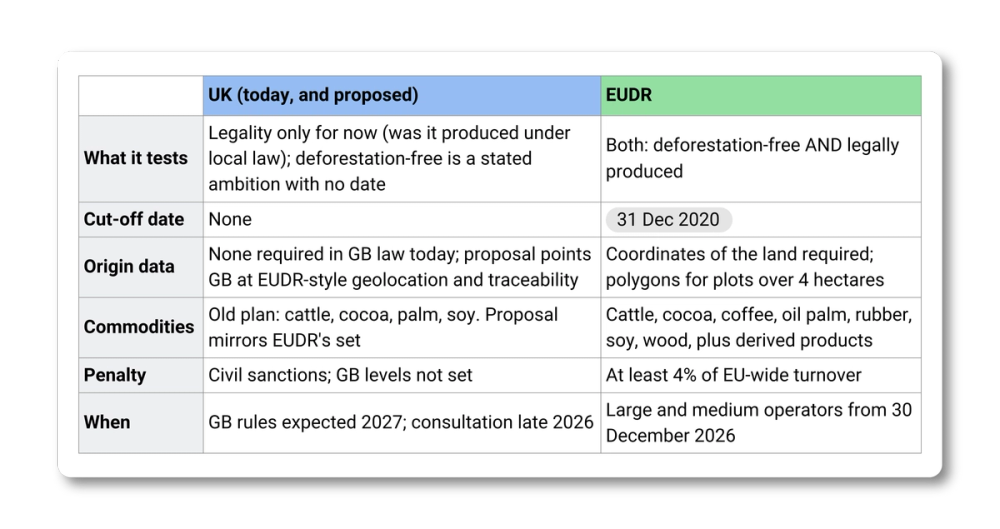
The thing to take from the table: the UK is being pointed at EUDR's commodity list and data standard, but the parts with teeth (a deforestation-free test, a cut-off date, mandatory geolocation) are still proposals and ambitions, not GB law.
What's actually in scope?
The old Schedule 17 plan covered four commodities: cattle, cocoa, palm oil and soy. The new proposal mirrors EUDR, so coffee, rubber and wood come in too, along with derived products. For a sense of scale, the government says UK consumption of these goods was linked to roughly 29,000 hectares of deforestation in 2023, about one and a half times the size of Manchester, and 9.4 million tonnes of carbon emissions.
Do I need plot geolocation now?
Not in GB law today. But this is the question that matters most, so read the proposal closely: it points GB at EUDR's "underlying information requirements," and under EUDR that means the coordinates of the land the commodity was grown on, as polygons for plots over 4 hectares. This is where the location framing earns its keep. A legality test asks whether a specific plot was lawfully used. A deforestation-free test asks whether that same plot was forest in 2020. Both are questions about the actual ground, not about how good your company's sustainability policy reads. So the origin data you build to answer one is most of what you need to answer the other, and the GB direction of travel is straight at it.
When does it actually bite?
For Great Britain, not until the rules are made, which the government expects in 2027. Northern Ireland is different: EUDR applies there in phases from 30 December 2026, under the Windsor Framework. So for a stretch the UK runs split: Northern Ireland under full EUDR this December, Great Britain under nothing binding until 2027.
What do we like about it?
A few things, genuinely. The direction is right: toward origin and location data, and toward a deforestation-free standard rather than a paperwork box. Matching GB's commodities and data requirements to EUDR is the smart move, because anyone selling into both the EU and Britain gets one standard to build for instead of two. And widening scope to coffee, rubber and wood closes gaps the old four-commodity plan left open.
What don't we like?
Start with the timeline. This is a consultation, not a law, and GB rules are a 2027 job while the EUDR clock runs out in Northern Ireland this December. The deforestation-free promise is undated ("in due course"), and until it lands GB stays legality-only, which means deforestation that is legal under a producer country's own laws still gets a pass. That gap is not small. WWF's analysis warns a legality-only standard could leave more than 2.1 million hectares of natural habitat deforestable legally in the Brazilian soy sector alone, and Global Witness warned the law risks "continuing some of the most damaging deforestation, just because it is deemed 'legal' in domestic laws". Thresholds are unresolved too: the old plan floated a 50 million pound turnover floor and a 500-tonne-per-commodity exemption, and the new regime's are still to be set. And the finance sector, which bankrolls a lot of this, is left out.
So what does this mean for me?
If you sell into both the EU (or Northern Ireland) and Great Britain, the takeaway is not "new law, panic." It is that the UK is converging on the same origin-data standard the EU already set, so the sensible way to treat this is as one capability, not one project per regulation. The hard part of all of it was never the paperwork. It is getting the coordinates of the land when your suppliers cannot or will not share them. That is the part Epoch builds: plot and supply-shed geometry derived from satellite, so a single origin-data layer answers EUDR today and the GB regime whenever it actually arrives. The thing worth watching is the consultation later this year, specifically where the thresholds land and whether "deforestation-free" finally gets a date.
If you'd like to learn more about how we generate plot-level geolocation without supplier data, or put the product to work in your supply chain, reach out to us here.
Or, subscribe to our newsletter to get the latest on supply chain risk management, EUDR, deforestation, water stress, and the latest trends in geospatial AI.