A decade of EU Timber Regulation paperwork carries into the EUDR. The two things not covered? The coordinates of the harvest plot and whether that plot was forest in 2020. Both are questions about the land, and a FLEGT licence answers neither.
Last updated: 23 July 2026.
Wood is the only EUDR commodity that has done this before. Traders in soy, cocoa, coffee, palm, rubber, and cattle are meeting a due diligence law for the first time. The timber trade has been subject to one since 2013, when the EU Timber Regulation (EUTR) banned illegally harvested wood from the EU market. So the wood industry walks into 30 December 2026 with a filing cabinet the others don't have: supplier records, species names, harvest-legality evidence, and maybe a FLEGT licence.
Most of that cabinet carries over. The genuinely new requirements of the EUDR look beyond existing documentation to directly assess the physical land where the wood was grown. Here are the questions wood businesses should know.
What actually changes for wood on 30 December 2026?
The EUTR gets switched off, and the EUDR takes its place, with a second test added on top. The EUTR asked one thing: was this wood harvested legally? The EUDR keeps that question and adds a new one: that the wood also be deforestation-free and covered by a Due Diligence Statement (DDS) before it can be placed on the market. Legality has evolved to become one component within the broader three-part criteria of Article 3.
The stakes moved too. EUTR penalties were set by each member state and varied widely. EUDR fines run to at least 4% of a company's EU-wide annual turnover. Same wood, same suppliers, a much larger downside for getting the answer wrong.
Will EUTR due diligence work carry over?
Mostly, yes, and more than people expect. Both regulations run on the same three-part machine: collect information, assess the risk, mitigate it where it's high. That structure doesn't change. Neither does most of what you feed into it.
Here is what explicitly transfers:
- The due diligence system itself: information plus risk assessment plus risk mitigation.
- Species data. The EUTR already required you to record the common and scientific name, and the EUDR still wants both.
- Country of harvest and your supplier and buyer traceability records.
- Legality evidence for the areas the EUTR already covered: harvest rights, the forest and environmental rules tied to harvesting, and trade and customs law.
- Your existing supplier relationships, documentation, and risk methodology.
If you built a working EUTR programme, you are not starting over. You're extending it.
What is new?
Three things, and two of them sit outside your paperwork entirely:
- Plot-level geolocation. The EUTR never asked for coordinates. The EUDR wants the geolocation of the plot the wood was harvested from, as polygons for areas over 4 hectares.
- The deforestation-free assessment. This is the whole second test, covering both deforestation and forest degradation, measured against a cut-off date of 31 December 2020. The EUTR had no equivalent. Nothing in your legality file answers it.
- The Due Diligence Statement. You now file a statement in the EU's information system before goods move, and hand its reference number down the chain.
There’s a fourth, quieter change: the legality test got wider. But the two that reshape the work are geolocation and deforestation-free. While traditional legality files outline producer permissions, the new requirements expand the focus to the physical origins of the wood and the historical state of the land in 2020. That’s a different kind of question, and it’s the one Epoch exists to answer.
What does "legal" mean under the EUDR?
Broader than "the logging was permitted." The EUDR defines the relevant legislation of the country of production as eight areas: land-use rights; environmental protection; forest rules including management and biodiversity conservation where they relate to harvesting; third parties' rights; labour rights; human rights; free, prior and informed consent; and tax, anti-corruption, trade and customs. Forest and harvest rules are the wood-specific slice. The rest may be new ground for a timber programme built around harvest permits.
Two things worth holding onto. Legality is determined exclusively by the national laws of the wood's country of origin. And it's a standalone condition. Wood can be perfectly deforestation-free and still fail EUDR because a land-tenure or labour rule was broken. The regulators running the EU's 2025 preparedness exercises were blunt about how hard this leg is, stating that "simply collecting data and documents is not enough".
Does a FLEGT licence get you off the hook?
Only for the legality half now. Under the EUTR, a valid FLEGT licence meant your timber skipped due diligence checks entirely. Under the EUDR, Article 10(3) treats a FLEGT licence as proof of legality and nothing else. The deforestation-free assessment, the geolocation, and the DDS all still apply. The licence covers one of the two tests.
And it covers it for very few countries. Only two run operational FLEGT licensing schemes: Indonesia, and Ghana, which went live on 15 August 2025 as the first African and second global FLEGT country. If you import licensed Ghanaian or Indonesian hardwood, the legality leg is largely handled and you still owe the deforestation verdict on every plot. If you source anywhere else, FLEGT was never the shortcut to begin with.
Which of my products are even in scope, and when?
Depends on whether the product sat in the EUTR Annex, sits in EUDR Annex I, or both. Three situations result, and they carry different timing.
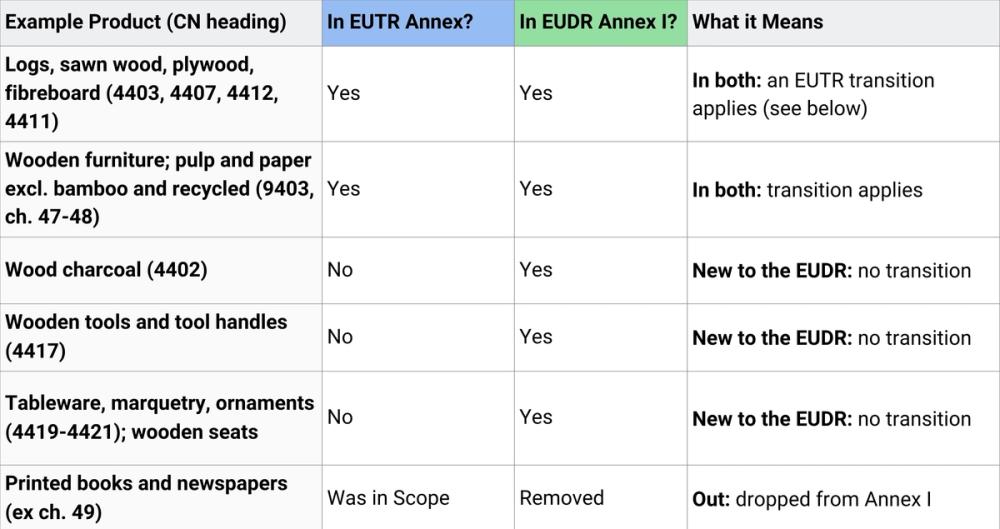
The lesson? EUDR Annex I is broader than the old EUTR Annex. Products the timber industry never had to diligence—wood charcoal, tool handles, wooden tableware and ornaments, wooden seats—are now in. Printed matter, which briefly sat in Annex I, was dropped from scope by the December 2025 amending regulation. One practical trap: packaging counts only when it's sold as a product in its own right. A wooden crate carrying someone else's goods is out of scope; the same crate sold empty as a crate is in.
Is there a transition period, or does everything switch apply once?
There is a transition phase. However, it's narrow and depends on when the wood was cut, not on who's trading it now. Traditional timber products (the ones in the old EUTR Annex) that were harvested before 29 June 2023 and placed on the market from 30 December 2026 stay under the EUTR until 31 December 2029. To use that, you have to be able to prove the harvest date. After 31 December 2029, the EUDR applies to that stock regardless.
Everything else is on the main clock, and for most wood in trade today that clock is 30 December 2026:
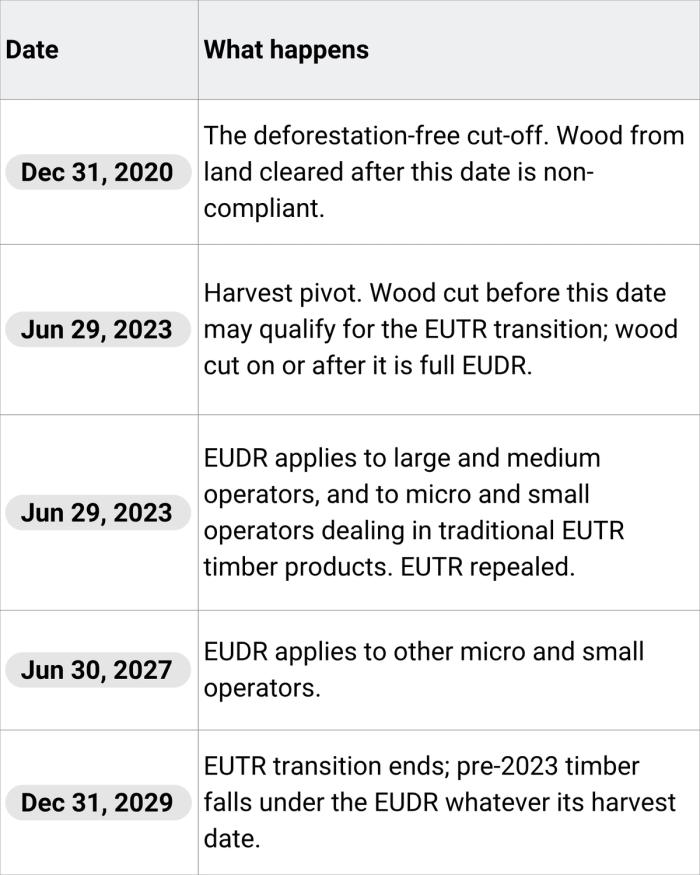
Note the line that catches small wood businesses: micro and small operators handling traditional timber products start on 30 December 2026, with everyone else. If you're a small joinery importer, the June 2027 grace period that other small operators get does not apply to you.
How do I pass the new tests?
A FLEGT licence and a supplier attestation describe legality on paper. Neither tells you the coordinates of the plot the wood came from, nor does it tell you whether that plot was forest on 31 December 2020. Those are facts about a specific piece of ground, and the only way to establish them is to look at the precise plot where it was grown.
That's the layer Epoch builds. We locate a supplier's facilities, map their supply sheds, detect the individual harvest plots inside those sheds, and run the deforestation assessment plot by plot against the 2020 cut-off. For legality, we flag where a legal problem is likely. The result is a defensible deforestation verdict and DDS-ready geolocation built on concrete, verifiable land data.
If you'd like to learn more about how we generate plot-level geolocation and run the deforestation assessment behind a wood DDS without supplier data, or put the product to work in your supply chain, reach out to us here.
Or, subscribe to our newsletter to get the latest on supply chain risk management, EUDR, deforestation, water stress, and the latest trends in geospatial AI.