Most of the world's soy production is used as feed, so most of your soy-linked deforestation risk is hidden in animal products—where a survey can't capture it, and regulation can barely see it.
Last updated 10 August 2026.
Weigh a kilo of farmed shrimp, or a supermarket chicken, and you're holding close to a kilo of soy. Broiler chicken carries about 956 grams of embedded soy per kilo, and farmed fish about 951 grams, because the soy was crushed into meal, fed to the animal, and turned into protein long before reaching the shelf. That invisibility is the whole problem.
If your company has spent the last two years getting ready for the EUDR 30 December deadline by chasing coordinates for the cocoa, coffee, and soybeans you buy directly, there's a real chance the largest slice of your soy-linked deforestation exposure isn't in any of those lanes. Here’s what you need to know.
How much of the world's soy is actually feed?
About 77% of global soy ends up as livestock feed. Our actual soy footprint is quietly tucked away feeding the chickens, pigs, cattle, and farmed fish we eat, rather than the visible soy products like tofu or cooking oil that people typically picture.
The consequence for a European buyer is stark. An average EU citizen's yearly soy footprint is around 60 kilos, and about 90% of it is embedded in animal products. Only a few kilos are eaten as soy.
Isn't feed exempt from EUDR?
Only partly. The regulation runs on a list of products, and finished compound animal feed isn't on it. Buy a formulated feed, place it on the EU market, and there's no due diligence statement to file on that product.
But the main protein ingredient inside that feed is a different story. Soybean meal, the oil cake left after crushing, is a relevant product under the regulation's Annex I, alongside the beans and the oil. So the exposure doesn't disappear. It just sits at a different point in the chain—a point often overlooked. Here's the map:
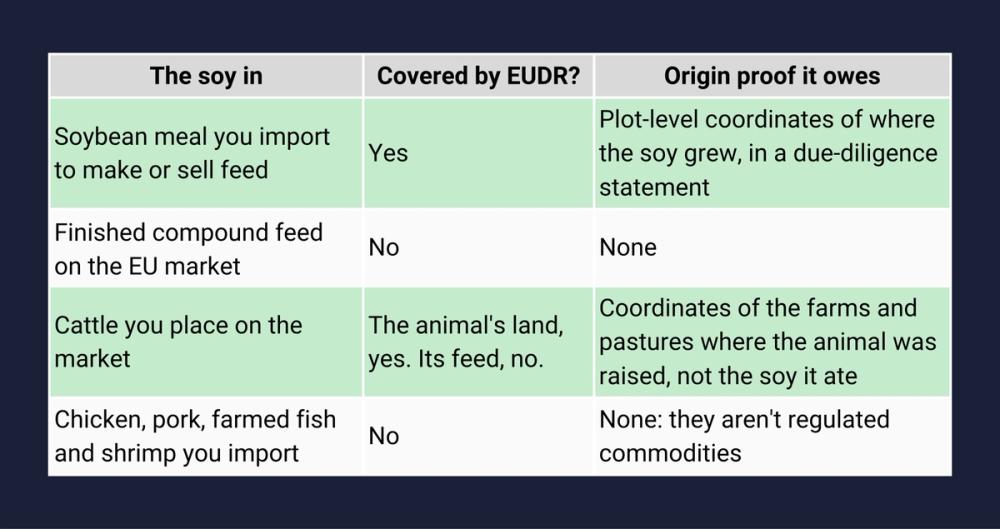
Even though deforestation risks are widespread across all imported animal proteins, official regulatory paperwork only tracks a tiny fraction of them.
So do I owe a due diligence statement on soybean meal?
If you place soybean meal on the EU market, yes, it's the same as any other commodity like cocoa or coffee. You need the geolocation of the plots the soy came from, checked against the 31 December 2020 cut-off, in a due diligence statement. A feed miller or a trader importing meal is an operator like any other, and a lot of them haven't noticed that the humble oil cake carries the same plot-level burden as the headline commodities.
What about the chicken, pork, and shrimp I import?
That's the real blind spot. Among animals, EUDR only covers cattle. Chicken, pork, sheep, and everything from aquaculture are exempt from the regulation entirely, so the soy fed to them—however much forest it costs—generates no due diligence obligation on the way into Europe.
Cattle look like the exception, but it is not as clear-cut as you may think. An operator placing beef on the market has to geolocate the farms and pastures where the animal was raised. But the Commission is explicit that "no geolocation information should be required for the feed itself". The rules expect beef and dairy operators to use deforestation-free feed, but they don't actually require the geolocation coordinates needed to verify it.
Why can't I just ask my feed supplier?
Because most soy arrives blended from many origins, a mill isn't going to unpick a shared tank for a customer's questionnaire. That blending is at the heart of the issue. Without facility-level data, "companies buying soy will remain blind to its origins, as mixing of different batches masks potential environmental risks." This point was just proven on a massive scale when the Amazon Soy Moratorium—a voluntary pact that kept the worst cleared soy out of major supply chains—collapsed in early 2026 after the main traders withdrew. One Brazilian research institute estimates that this will result in up to 30% more deforestation of the Amazon by 2045. The backstop most buyers were quietly relying on is gone.
Isn't this just an ESG-data problem?
No. It's a location problem, and that distinction is the whole point. Regulatory compliance is less about grading corporate policies or checking supplier questionnaires and more about physically matching ingredients to the exact plot of land where they grew.
This is what production geography means in practice. The EU's imported deforestation runs to roughly 112,500 hectares a year, and soy from Brazil alone accounts for about 13,600 of them. None of those hectares are visible in an ESG score. All of them are visible from orbit.
Why does this matter now, and not next year?
While direct imports have immediate paperwork requirements, the soy hidden inside imported animal feed presents a different kind of threat—a major reputational and supply risk. Brazilian law allows a landowner to legally clear 65 to 80% of a property, against 20% in the Amazon. Even if it is legal, clearing is still deforestation under EUDR's 2020 cut-off. Deforestation that can only be caught with plot-level checks.
How do you actually see the soy behind the feed?
Because complex supply chains source and blend soy from various regions, sending supplier surveys is a gamble; the only reliable way to trace origins is by mapping the growing plots directly. Locate and map the mills and crushers where the feed originates, identify the individual production plots inside those supply sheds, and assess each one for deforestation against the 2020 cut-off.
This is the part Epoch works on, and it's why the feed problem is squarely in our lane. Origin data you can't ask for, you have to derive from the land itself. So the honest belief to walk away with is this: the biggest hidden share of your soy-deforestation risk is riding in animal feed, where the rules mostly can't see it and a survey can't retrieve it, and the only way to know it is to read the origin off the ground.
Pick one animal-protein or feed lane this month and ask your team a single question: can we show where the soy in this feed was grown, at plot level, or would we have to ask the supplier and hope? The answer tells you whether you have a feed problem and if so, how big it is.
——————————————————————————————————————
If you'd like to learn more about how we derive plot-level soy origin and supply-shed deforestation risk without supplier data, or put the product to work in your supply chain, reach out to us here.
Or, subscribe to our newsletter for the latest on supply chain risk management, EUDR, deforestation, water stress, and new trends in geospatial AI.