By William Ouellette, CTO. The Information System now checks the shape of your plot file. An inspector checks whether those plots can account for what you shipped, what was cleared around them, and where the product was mixed with other material before reaching port.
Last updated 12 November 2026.
Earlier this month we worked on a timber case in which the supplier sent Epoch two plots. Together they could yield a dozen or so cubic metres of wood. The same supplier's import record for 2024 totalled several thousand cubic metres. We determined the plots were compliant, yet nothing in the file explained how the supplier kept the wood from those two plots separate from everything else it handled. That missing explanation is the first thing an inspector will ask for.
We think the first EUDR inspections will hinge on whether the plots you declared can account for the product you shipped, and on what sits around those plots. Based on our work with wood and cocoa importers, and on the authorities' dry-run reports, we believe that whether each declared polygon passes a forest check will matter less. The regulation applies from 30 December, 48 days from now, and the penalty floor is 4% of EU turnover.
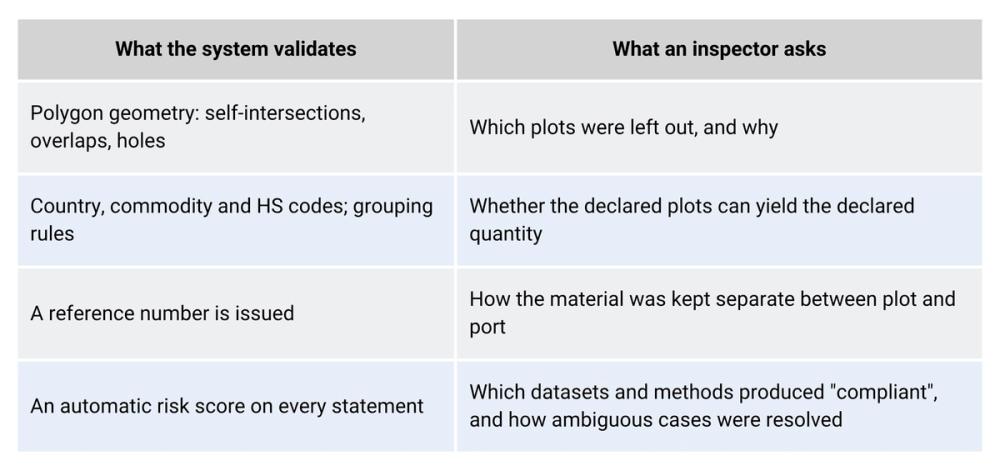
The Information System, where statements are filed, will not answer that question for you. Its latest update, announced on 9 November, added stricter checks on the plot file itself. It tests whether the file is in the right format (GeoJSON, a standard map-data format), whether each plot outline is drawn correctly, and whether the plots sit in the declared country. Those checks tell you the file is well formed. They say nothing about whether the plots are the right ones. The authorities who ran the dry runs said so directly: operators "cannot hide behind a general DD-System". They are expected to provide "evidence directly relevant to the specific shipments selected for inspection".
1. The land around the plots
People close to the dry runs tell us what makes an inspector look twice. The triggers are a clean polygon surrounded by recent clearing, a farm far from any collection point, a boundary drawn neatly along a national park, and sourcing near a border. The European Forest Institute's report on the coffee exercise, run with the Belgian and French authorities on four shipments, puts the standard in one sentence. A clean plot dataset is one thing. Another, in its words, is "the ability to evidence that specific shipments are actually linked to these origins" and that no "problematic plots" were "conveniently removed from the dataset".
The regulation names these criteria. Article 10(2) requires every risk assessment to cover "the complexity of the relevant supply chain", including "difficulties in connecting relevant products to the plot of land". It also names "the risk of circumvention of this Regulation or of mixing with relevant products of unknown origin".
The verdict on the plots themselves is also open to challenge. We wrote in March that the authorities look inside and around the plot. What is new this autumn is how often two providers disagree about the same plots. In two cocoa supply bases we reviewed this month, another provider passed every plot. We flagged seven of about 190 in one and a dozen in the other, and the before-and-after imagery supported the flags. An inspector will ask which datasets were used, which method, and how the disagreement was resolved. Mayer Brown's note on the same exercises records the authorities' position: due diligence "cannot be delegated to third-party service providers".
2. The arithmetic between plots and product
The timber case is a volume question, and volume questions are the cheapest an inspector can investigate. If the plots cannot produce the tonnage in your containers, the balance came from land you have not declared. If the harvest permit postdates the shipment, the wood came from an earlier cut. Mayer Brown lists "yield checks" among the evidence the authorities requested.
The scale of what can sit behind a short plot list is public. Fern and three Indonesian NGOs reported on 2 November that Indonesian regulators have documented more than 430 palm plantations on over 3 million hectares of designated forest estate. A supplier in that landscape can send you ten clean plots. The arithmetic tells you whether ten plots is the supply base or a sample of it.
3. The route between plot and port
Origin is usually lost at a tank or a yard. Rainforest Action Network published an investigation on 28 October tracing crude palm oil from mills whose affiliated concessions cleared more than 9,300 hectares between January 2021 and May 2026. The oil travelled by barge to a bulking station on the Mahakam River, where RAN says it was "commingled in common bulking tanks", then on to a refinery. The company denies commingling and any relationship with the concessions. The mechanism is the one the dry-run reports have in mind when they ask for "segregation protocols throughout supply chains". For cocoa the junction is the collection point, for timber the sawmill yard, and for palm the mill and the tank. The filing only shows the plots.
The same question outside EUDR
Nothing here is specific to deforestation. The Commission's Forced Labour Regulation guidelines say an inability to provide traceability where a product "may have been mixed" with a high-risk one "may weigh negatively". That regulation applies from 14 December 2027. The UK government committed on 4 November to mandatory human rights due diligence and to a regulator that can order goods made with forced labour off the market. In the United States, UFLPA already requires the importer to show "by clear and convincing evidence" that goods were not made with forced labour. In each case the question is whether the origin you can show accounts for the product you hold.
What to check before the first statement goes in
Take one supplier's plot file and run three checks. Total the plausible yield of the plots and set it against last year's volume from that supplier. Look at what was cleared within sight of the plots since 2020, and whether any boundary follows a park or a border. Document every point between plot and port where the material physically mixed, and what evidence covers each one. Where you cannot answer, you have found the part of the file an inspector will ask about.
At Epoch this is the order we work in. We build the sourcing area around each mill or collection point from its address and detect clearing and harvest inside it. We check the plot geometry, compare several forest-loss datasets against before-and-after imagery, and keep the method and the exclusions in an audit trail a third party can reproduce. The result is a record of what is on the ground around each supplier, whether or not the supplier sent it.
If you'd like to learn more about how we assess a supplier from a name and an address without asking it for anything, or put the product to work in your supply chain, reach out to us here.
Or, subscribe to our newsletter to get the latest on supply chain risk management, EUDR, deforestation, water stress, and the latest trends in geospatial AI.