The global food system has a greater impact on the planet than any other human activity. As our population continues to grow, so does demand—a compounding pressure on our renewable resources.
In response, the Codex Planetarius initiative has proposed a system of minimum environmental performance standards for globally traded food. Modeled on the safety standards of the Codex Alimentarius, this initiative aims to measure key environmental impacts, such as deforestation and emissions, in order to establish a baseline for acceptable performance in global trade.
Epoch’s first-mile mapping technology is making this vision a reality. By tracing the journey from the individual plot to the first point of aggregation, we address the industry's visibility challenge, transforming obscure commodity supply chains into data-driven landscapes.
Ditching Distance Buffers
The "first mile" in agricultural supply chains has always been challenging to delineate. Exactly where a raw material is grown has not been easily linked to its subsequent processing facilities.
Epoch's approach goes beyond conventional mapping that relies on imprecise distance buffers or incomplete datasets, opting to plot supply sheds based on travel-time isochrones. Accounting for road networks, topography, and the specific freshness requirements of the commodity allows us to calculate the probable sourcing area more effectively.
This establishes a probabilistic relationship between commodity-producing areas and the mills that aggregate them. Thus, ensuring a systematic and representative assessment of environmental performance and creating a comprehensive profile with deforestation, emissions, and water stress metrics for every facility.
A Comprehensive Analysis of Indonesian Palm Oil
To prove the viability of this framework, Epoch conducted a pilot study investigating the palm oil sector in Indonesia. We analyzed 1,290 aggregation facilities, linking them to over 10 million hectares of commodity production.
This was not a sample; it was a comprehensive, country-wide analysis of a single product. The results validate the core premise of Codex Planetarius: environmental impact is not spread evenly. It is intensely concentrated.
The 5% Rule: Concentrated Risk and Impact
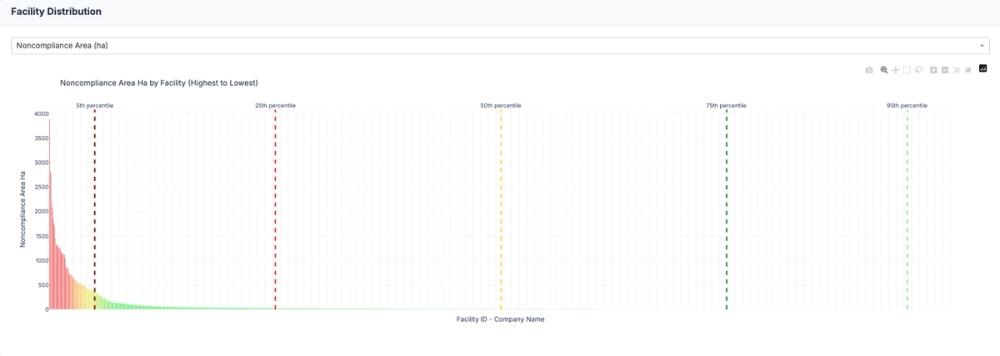
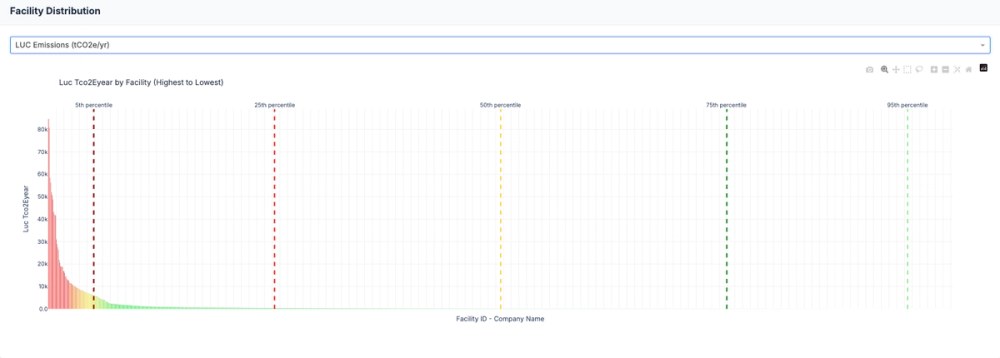
The data reveal that a small minority of "bottom performers" are responsible for the vast majority of environmental impacts. By assessing all mapped facilities in Indonesia, we discovered that the bottom 5% of facilities are associated with 73.3% of all post-2020 deforestation and account for 77.9% of total Land Use Change (LUC) emissions.
What's more, these bottom-performing facilities account for only about 5.5% of the total annual production capacity.
Why This Matters
The assumption that risk is ubiquitous across a supply chain often leads to paralysis or inefficient, broad-brush sustainability programs. Epoch’s supply shed analysis demonstrates that risk is specific, identifiable, and manageable. For downstream players, this concentration of risk fundamentally changes the sustainability strategy.
The data proves that you do not need to overhaul 100% of your supply chain to achieve massive sustainability gains or resilience improvements. By identifying and targeting the bottom 5-10% of producers, stakeholders can address the majority of environmental harm. This makes intervention strategies more efficient and cost-effective. Our supply shed analysis reveals trade-offs that broad certifications might miss, allowing companies to pinpoint exactly where interventions are needed to address deforestation, emissions, water stress, and biodiversity unsustainable metrics. With regulations like the EU Deforestation Regulation (EUDR) coming into force, the ability to trace deforestation to specific plots and aggregation points is no longer optional. Our methodology aligns with EUDR definitions, providing the granular, plot-level data required for compliance, even if the supplier is unable to provide the plots.
Conclusion
Epoch’s work with Codex Planetarius demonstrates that a targeted, data-driven approach is the most efficient path toward systemic change. By utilizing state-of-the-art supply shed delineation, we provide the "first-mile" visibility necessary to identify the producers that are responsible for the majority of environmental harm.
Epoch can help you leverage this framework and move from vague sustainability commitments to precise, impactful action for the global food trade.