For SME operators that have to file, the step most likely to fail is asking overseas suppliers for plot coordinates. The critical nuance: the regulation accepts evidence you can produce yourself directly from the supplier’s location.
Last updated 5 October 2026.
Does EUDR even apply to a business my size?
Probably, if you import or sell the seven commodities. The Commission's 2025 SME factsheet, since taken offline, put SMEs at 90% of the operators importing products in scope, and its May 2026 report keeps the lighter rules for small companies. An SME is a company that meets two of three tests: up to 250 employees, turnover under EUR 50 million, and balance sheet under EUR 25 million. The seven commodities covered are cattle, cocoa, coffee, oil palm, rubber, soya and wood, and any products made from them. Whether you have to do anything depends on your role in the chain, not on your size alone.
Do I actually have to file anything?
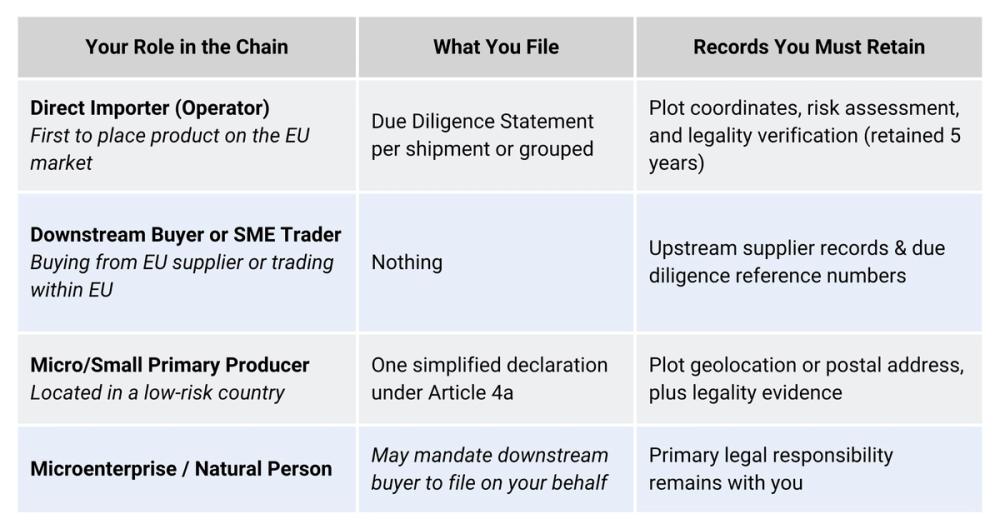
Often not. The regulation places the burden on the first company to place a product on the EU market. If you buy from an EU supplier that has already filed, or you buy and sell exclusively within the EU, you do not file; you simply retain reference numbers. If you import the product yourself, you are the operator—and the duty is yours. The table below sets out the positions.
When does it start for me?
Two dates and two conditions:
- Large and medium operators and traders: 30 December 2026.
- Micro and small enterprises: 30 June 2027, provided both conditions are met:
- The business qualified as micro or small on 31 December 2024.
- The product is not a timber product previously covered by the EU Timber Regulation (importers of wooden furniture, pallets, or flooring must meet the December 2026 date regardless of size).
- Note: Micro and small primary producers in low-risk countries file one simplified declaration rather than a statement per shipment.
What does "geolocation" mean when I have six suppliers?
The same as it means for a company with six thousand. The statement requires the exact coordinates of every plot where the commodity was grown, including polygon boundaries for plots over four hectares. The Commission's FAQ is unequivocal: "There is no exception for the traceability requirement via geolocation."
If you cannot obtain this data, you "must refrain from placing or making available the relevant products on the EU market." The penalty floor is 4% of EU turnover. Inspection rates are tied to country risk: authorities check 1% of operators sourcing from low-risk countries, 3% from standard-risk, and 9% from high-risk (Côte d'Ivoire, Ghana, Brazil, Indonesia, Malaysia and Vietnam are all classified as standard-risk).
What if my suppliers don't answer?
They often won't—and standard compliance advice assumes an enterprise relationship that small businesses simply do not have. Compliance software guides routinely acknowledge that outreach is the longest bottleneck. A May 2026 market review confirmed that "most tools are built for large enterprises".
Compliance platforms we work with report that most suppliers in their programmes never return plot data—even when requested by buyers with substantial purchasing leverage. A boutique coffee roaster buying from two exporters or a furniture importer buying from a single overseas mill has virtually no leverage. Fewer than 12% of palm companies disclose plantation coordinates at all. Waiting on an email reply is the single greatest compliance risk facing small importers.
Is there a route that doesn't depend on the supplier?
Yes, and the regulation explicitly provides for it. Commission guidance confirms that "remotely sensed information (air photos, satellite images)" may be used to verify plot compliance. This route works backwards from what you already possess: the supplier's name and physical address.
- Resolve the facility.
- Delineate the plausible sourcing shed.
- Detect the plots within that shed.
- Screen each plot for land-use change post-31 December 2020 and verify against the local public legality record.
None of this depends on a supplier answering a survey. Two operational caveats remain. Your filing still requires plot coordinates; under this route, they are derived from verified detected plots rather than a supplier questionnaire. Flagged plots must still be resolved, meaning you only contact suppliers about specific anomalous plots rather than burdening them with blanket requests.
Is this only an EUDR problem?
No. Sourcing traceability is quickly becoming mandatory across global supply chains:
- UK Forest Risk Commodities: The planned GB regime kicks in at a GBP 1 million turnover threshold—well within SME scope.
- EU Forced Labour Regulation: Enforceable from 14 December 2027 with no SME exemption, explicitly listing "satellite imagery and geolocation of facilities" as evidence while penalizing an inability to provide traceability.
- Amended CSDDD: Mandates that large corporations request data from suppliers with under 5,000 employees "only where the information cannot reasonably be obtained by other means".
As a supplier, you are shielded from excessive questionnaires; as an importer, you are pressured to issue them. Automated remote assessment resolves both dilemmas.
How does the assessment route work in practice?
Three steps. List your suppliers and determine your filing posture from the matrix above; most SME lines end in "nothing to file". For lines where you are the primary EU placer, decide whether you will wait on supplier questionnaires or independently verify the facility using remote sensing. Then check the two conditions on the June 2027 date before you plan around it. At Epoch, we built a self-serve platform designed specifically for this workflow. Upload your supplier names and addresses; our system assesses the plots and public records without supplier outreach, resolves flagged plots individually, and exports a ready-to-file due diligence statement in the official EU format.
If you'd like to learn more about how we assess a supplier from a name and an address without asking it for anything, or put the product to work in your supply chain, reach out to us here.
Or, subscribe to our newsletter to get the latest on supply chain risk management, EUDR, deforestation, water stress, and the latest trends in geospatial AI.