The Commission adopted the EUDR's final product list and its filing rules on the same day. The list is fixed until 2030. Every statement is now scored silently, and the thing the statements stand on, the coordinates of the land, didn't move at all.
Last updated: 13 July 2026.
Somewhere in your company, there's a spreadsheet that maps your products to EUDR HS codes. As of this morning, it needs a new column because different rows now carry different deadlines.
On 13 July, the European Commission adopted two acts: a delegated act that determines which products are subject to due diligence, and an implementing act that decides how due diligence statements move through the Information System. Most of the coverage we’ve seen so far on this reiterates the product list, but that's a small piece of the puzzle.
Here's the whole picture and the real questions operators are asking.
What did the Commission actually adopt?
The EUDR runs on two things: a list of products that trigger due diligence (Annex I) and a database where every due diligence statement (DDS) gets filed before goods can be placed on the EU market (the Information System). With these updates, they have finalized both parts. The delegated act finalises the list. The implementing act sets the system's rules.
One thing to note: adopted isn't in force. The delegated act still has to clear European Parliament and Council scrutiny, then must be published in the Official Journal, before it technically applies. The PDFs on the Commission's pages are literally stamped as drafts of the adopted text.
The updated list is unsurprising to most. In the feedback round that closed on 1 June, about 40% of respondents pushed past the draft's technical fixes and asked for products to be added or removed. What they asked for was targeted exceptions rather than blanket ones. That's roughly what came back. The new palm-derivative entries carry an exclusion for products "used in the manufacturing of medicinal products for human or veterinary use," a carve-out that appeared after that feedback round.
Am I still in scope?
If you trade the seven commodities themselves, yes, nothing moved. Cattle, cocoa, coffee, oil palm, rubber, soy, and wood remain subject to the regulation itself, outside any delegated act's reach. The movement is all at the edges and acts as a two-way street. Here is a brief guide to the changes made:
Removed From Scope - Applies after publication
- Cattle hides, skins and leather (HS 4101, 4104, 4107)
- Conveyor and transmission belts (4010)
- Other vulcanised rubber articles, including gaskets and seals (4016)
- Retreaded tyres, narrowed to just the new tyre tread (4012 90 30 stays in)
- Soya beans for sowing
- Aircraft and motor-vehicle seats
Added to the Scope - Applies 30 December 2027
- Soluble coffee (2101 11 00)
- Frozen cattle tongues
- Sixteen oil-palm derivative entries across the oleochemicals chain:
- Hydrogenated and modified palm oils, crude glycerol, fatty alcohols, fatty acids, palm-based soap bars and soaps, and related chemical products
Clarified, Still in Scope - Applies with the act
- Wooden seats (six specific codes replace the old blanket seats entry)
- Palm-oil entries qualified as "synthesized using oil palm"
- Species notes: cattle means genus Bos only, oil palm means Elaeis only, rubber means Hevea brasiliensis only, wood excludes bamboo and rattan
Two footnotes on the edges. The horizontal exemptions now reside in the Annex itself, including samples, products for testing and analysis, waste, used and second-hand goods, packing material carrying another product, and marketing materials. And several asks were refused—prepared beef (1602 50) and cocoa shells and waste (1802) stayed in because they passed the Commission's cost-benefit test, while rubber balloons, liquid soaps, surfactants, and wood-plastic composites stayed out because they failed it.
Don't file this under cosmetics. Compliance leads at global manufacturers describe classification as the grind that never finishes. Even good programs top out around 90% of materials mapped, and whether you're the operator or a downstream operator can be unclear from shipment to shipment. Sharper edges and species notes kill real ambiguity at customs.
When does any of this actually apply?
On three different clocks, which is why the spreadsheet needs the new column.
The awkward one is the entry into force, the date nobody can pin down yet. Delegated-act scrutiny typically runs about two months and can be extended, which lands it somewhere in Q4 2026. So a leather or rubber-parts trader may formally leave scope only weeks before the 30 December application date. Until the Official Journal publishes, the removals aren't law yet, and building your December plan on them is a bet on the calendar.
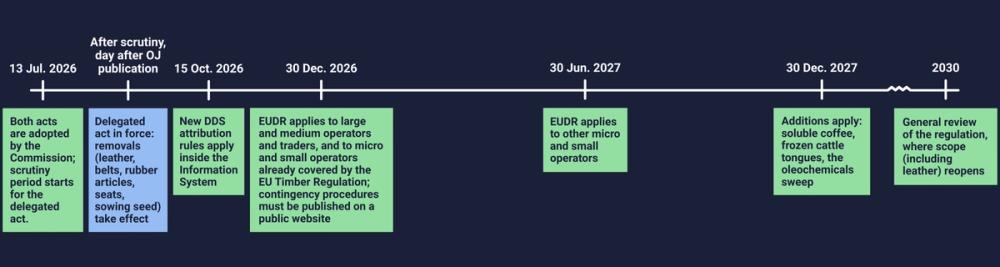
So did the EUDR just get smaller?
It depends on which ledger you read. By trade value, it grew. By measured deforestation, it shrank. Both are true, and both are worth holding at once.
The Commission assessed €9.3 billion per year of requested additions against €2.5 billion of requested removals, and most of the additions made the final act (biodiesel and animal feed are the big ones that didn't). The removals are associated with an assessed 40,900 hectares of embedded deforestation annually—mostly leather—while the additions equate to only around 7,400 hectares.
For scale, the current scope is 76 product codes and about €85 billion per year in imports, capturing an estimated 228,000 hectares of embedded deforestation annually. The edges may have moved, but the core did not.
What's this "grouping" thing?
The EU's answer to files that got too big. Plot-level geolocation makes statements heavy: the system ingests GeoJSON, and past guidance capped upload sizes and suggested swapping small plots from polygons down to points to squeeze under the limit.
The new act goes the other way. You file statements in pieces, then submit one new DDS that references the earlier ones by their identifiers. The grouped statement legally stands in for all of them, and you hand one group reference number downstream and to customs.
Two standouts. Once a statement is referenced in a group, it freezes and cannot be amended or withdrawn. And the Commission now has the power to set file-size and frequency limits and to block "incorrect, superfluous or duplicated data," which reads like a system bracing for operators who upload everything they can find. In other words, volume isn't a compliance strategy because every plot you declare is a plot you're liable for.
What if I'm a downstream operator or a small producer?
Then this just got easier for you, and it's now written down properly. Since the December 2025 amendment, downstream operators and traders are not required to submit statements at all; you collect and pass on the statement reference numbers upstream. In practice, those numbers are becoming ERP master data held against delivery notes, and the teams we speak to plan exactly that. Micro and small primary producers file a lighter "Simplified Declaration" instead of a full DDS, and Member States can pre-fill those from existing national databases, with the system issuing each producer a declaration identifier.
One nuance that catches wood businesses: micro and small operators already covered by the old EU Timber Regulation start on 30 December 2026 with everyone else, not in the June 2027 SME wave.
What happens if the system goes down in January?
There's finally a written answer. By 30 December 2026, the Commission must run a public page showing whether the Information System is up. If an unplanned outage exceeds 60 minutes, contingency kicks in: you will be notified and trade on contingency reference numbers until the system is back. The act also cuts the system's formal tie to the TRACES infrastructure and requires web service access under common technical specifications—the plumbing that lets compliance software file machine-to-machine instead of someone retyping statements into a portal.
What’s good, bad, and ugly?
Credit where it’s due. Six months out, operators finally have a settled list, with the next scope fight parked at the 2030 review. Additions get a 17-month runway to 30 December 2027, which is how deferred application should work. Grouping is an honest fix for a real technical problem. And writing outage procedures into law beats improvising them if an outage occurs.
The complaints are specific. The scrutiny calendar leaves leather and rubber traders guessing whether they de-scope weeks before or after the deadline. The risk score on your statement is invisible to you, so there’s no feedback loop on what triggers a hold. And the new palm entries are scope-conditional on feedstock (“synthesized using oil palm”), so a chemicals importer has to trace provenance just to find out whether they’re in scope at all. That’s an origin question sitting in front of the origin question.
Trading up to €2 billion per year in assessed environmental benefit for €16.7 million of cost relief to relieve database load is a hard trade to defend. And it allows leather-linked deforestation to continue until the regulation review in 2030.
What does December look like?
This update settled who files and hardened how filing works. It didn't touch what filings stand on. The core test is what it always was: a DDS is a claim about specific plots of land, backed by coordinates for every plot, polygons above four hectares, checked against the 31 December 2020 cut-off and the producing country's laws. If your product list moved, re-run the code triage against the three dates above. If it didn't, your December risk lives where it always did: in the coordinates.
A statement built on thin or borrowed geolocation carries a priceable risk: a hold at the border window, a rejection, goods that legally can't move. That part is what Epoch builds. We generate the first-mile layer behind the statement—locating supplier facilities, mapping their sourcing supply sheds, detecting the individual plots within them, and running the deforestation assessment plot by plot, so you never need supplier-collected data. What comes out is DDS-ready geolocation that's been screened before anyone files it, so the statement you group, pass downstream, or defend in an audit isn't carrying a flag you never saw.
If you'd like to learn more about how we build the plot-level geolocation and screening layer behind a DDS, or put the product to work in your supply chain, reach out to us here. Or subscribe to our newsletter to get the latest on supply chain risk management, EUDR, deforestation, water stress, and the latest trends in geospatial AI.