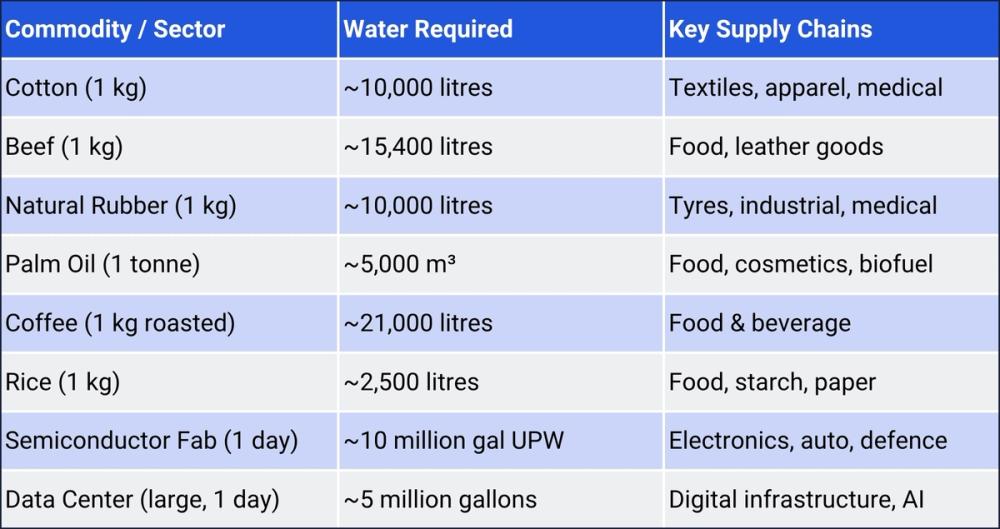
Water is the invisible raw material running through virtually every global supply chain. Consider the sheer volume required to power modern industry and agriculture: a single tonne of palm oil demands approximately 5,000 cubic meters of water, a pair of jeans takes roughly 10,000 liters , and a semiconductor fabrication plant requires approximately 10 million gallons of ultra-pure water every day .
However, we are rapidly approaching a breaking point. The United Nations projects that global freshwater demand will outstrip supply by up to 40% by 2030 , driven by urbanization, population growth, and the intensification of water-hungry industries. Climate change is compounding this scarcity with severe unpredictability, lengthening seasonal drought cycles and shifting rainfall patterns. Consequently, as freshwater becomes scarcer and more contested, water stress has evolved from a background sustainability concern into a front-line operational risk.
A Systemic, Multi-Industry Shock
Because water risk is fundamentally localized and basin-specific, its disruption to supply chains is uniquely devastating. A single drought event in a concentrated geography can simultaneously send shockwaves across multiple downstream industries.
A stark example is the Taiwan drought of 2021, which struck the world's most critical node for semiconductor manufacturing. During this event, a year without the seasonal typhoons left key water basins below 20% capacity . Taiwan produces over 60% of global semiconductors and 90% of the most advanced chips . As a result, 31 chip-fabrication sites faced mandatory water withdrawal restrictions . The downstream outcomes were severe: global automotive manufacturers and electronics companies, already navigating COVID-era supply crunches, found their production schedules paralyzed by hydrology.
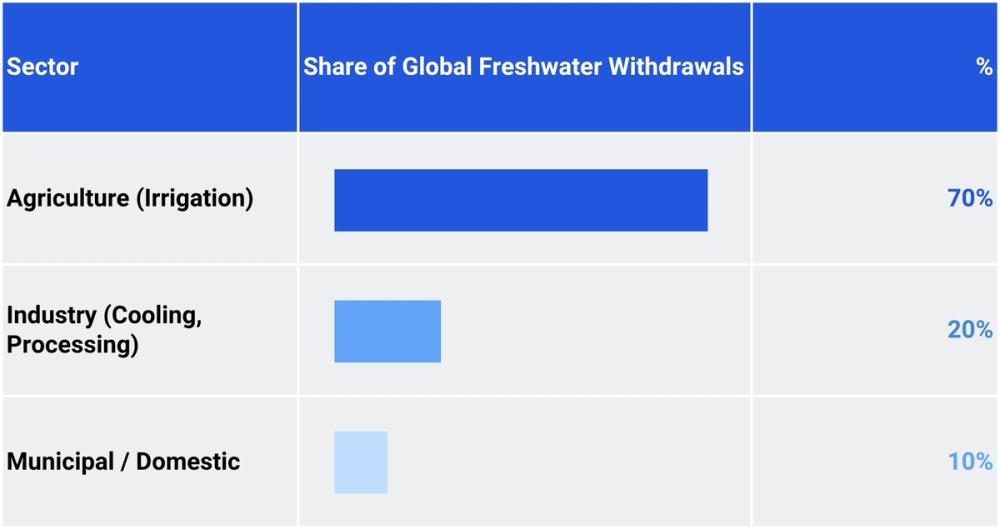
Similar disruptions are heavily felt in global agriculture, which accounts for roughly 70% of global freshwater withdrawals . During the 2015–2016 El Niño, a severe drought hit the palm oil growing regions of Sumatra and Kalimantan in Indonesia. Because oil palms are highly sensitive to water stress, the reduced rainfall drastically cut yields . The outcome was a sharp drop in Indonesian palm oil production and subsequent global price spikes that affected food manufacturers, personal care brands, and biofuel producers globally.
The Human Cost of Water Prioritization
Beyond the immediate economic disruptions, extreme water stress forces impossible policy choices that manifest as severe human impacts and social risks. When shortages occur, governments must prioritize who receives water. During the 2021 Taiwan drought, the government resolved the prioritization crisis by paying rice farmers subsidies to leave their fields fallow for three consecutive years, redirecting that agricultural water to the semiconductor fabs . While this protected the highly lucrative chip exports, it created immense social tension, with farmers in the region .
The broader social implications are profound. The World Bank estimates that climate-driven water scarcity could displace between 24 million and 700 million people by 2050. When agricultural hubs lose their water security, displaced populations lead to disrupted labor pools for essential commodities like palm oil, rubber, and cocoa. Furthermore, as agricultural workers migrate in search of livelihoods, they often move to regions with weaker labor protections, dramatically increasing the risk of labor exploitation within the supply chains of food, textiles, and electronics.
The First-Mile Visibility Challenge
Historically, attempting to identify and monitor these risks deep within the supply base has been an arduous and often fruitless task for procurement teams. Surveying suppliers directly, with roughly a 10% response rate was creating significant blind spots when it came to supply chain risks. This reliance on cascading questionnaires is particularly ineffective when dealing with agricultural commodities because Tier N suppliers are often unable to provide the required data. Furthermore, simply categorizing risk at the country level is fundamentally flawed. With the highly localized nature of watershed risks , “Indonesia" or "Brazil" are not meaningful water risk categories. A palm oil plantation in Sumatra and one in Sabah can face entirely different water conditions in the exact same year despite being just 600 kilometers apart.
Mitigating Risk with Epoch
True supply chain resilience requires geographic diversification. Moving sourcing across borders while keeping it in the same river basin or hydrological region provides little actual water risk mitigation. To build strategic resilience requires sourcing from locations with structurally different water budgets and climate exposure. To achieve this, companies must have visibility into the specific watersheds where their farms, mines, and factories operate.
This is where Epoch delivers transformative capability by elucidating previously opaque tier N data. By enabling procurement teams and supply chain platforms to understand water conditions at the specific locations where their supply originates, without requiring a single supplier questionnaire Epoch provides the foundational capacity for resilience. In combining satellite data streams—including CHIRPS precipitation data, MODIS evapotranspiration mapping, and NASA SMAP soil moisture percentiles—Epoch is generating a highly precise, composite Water Stress Index for any specific plot or facility.
The plot-level precision Epoch offers is a profound operational advantage. Rather than generalizing risk, a procurement team can accurately analyze the supply shed of individual processing mills or factories. This actionable intelligence allows businesses to diversify sourcing across water basins, not just geographies and strategically build inventory buffers for materials originating in vulnerable regions before a drought peaks.
Water stress is no longer an abstract future possibility; it is an immediate physical and economic reality disrupting operations around the globe. By integrating first-mile water intelligence into sourcing and procurement strategies, businesses can transition from reactive crisis management to proactive supply chain resilience.